In Braga, APA’s president says Portugal needs to “race” to meet waste targets.
José Pimenta Machado, president of the Portuguese Environmental Agency (APA), expressed regret today that Portugal sends 50% of its waste to landfills and warned that “we need to pick up the pace and make changes,” as the goal is to reduce this figure to 10% by 2035.
Speaking to journalists in Braga—where he took part in an awareness-raising event for the “Let’s separate the waste” campaign—José Pimenta Machado was blunt in his assessment of the country’s waste management performance.
“The bad news is that, over the last seven years, our figures for separate waste collection have stagnated; they haven’t risen above 20%. We want to see a significant increase, particularly regarding bio-waste (…). And more than 50% of waste goes to landfills. It is no longer possible to build new landfills in Portugal. Therefore, the focus must be upstream—on collection, prevention, and generating less waste. That is where our hope lies,” he said.
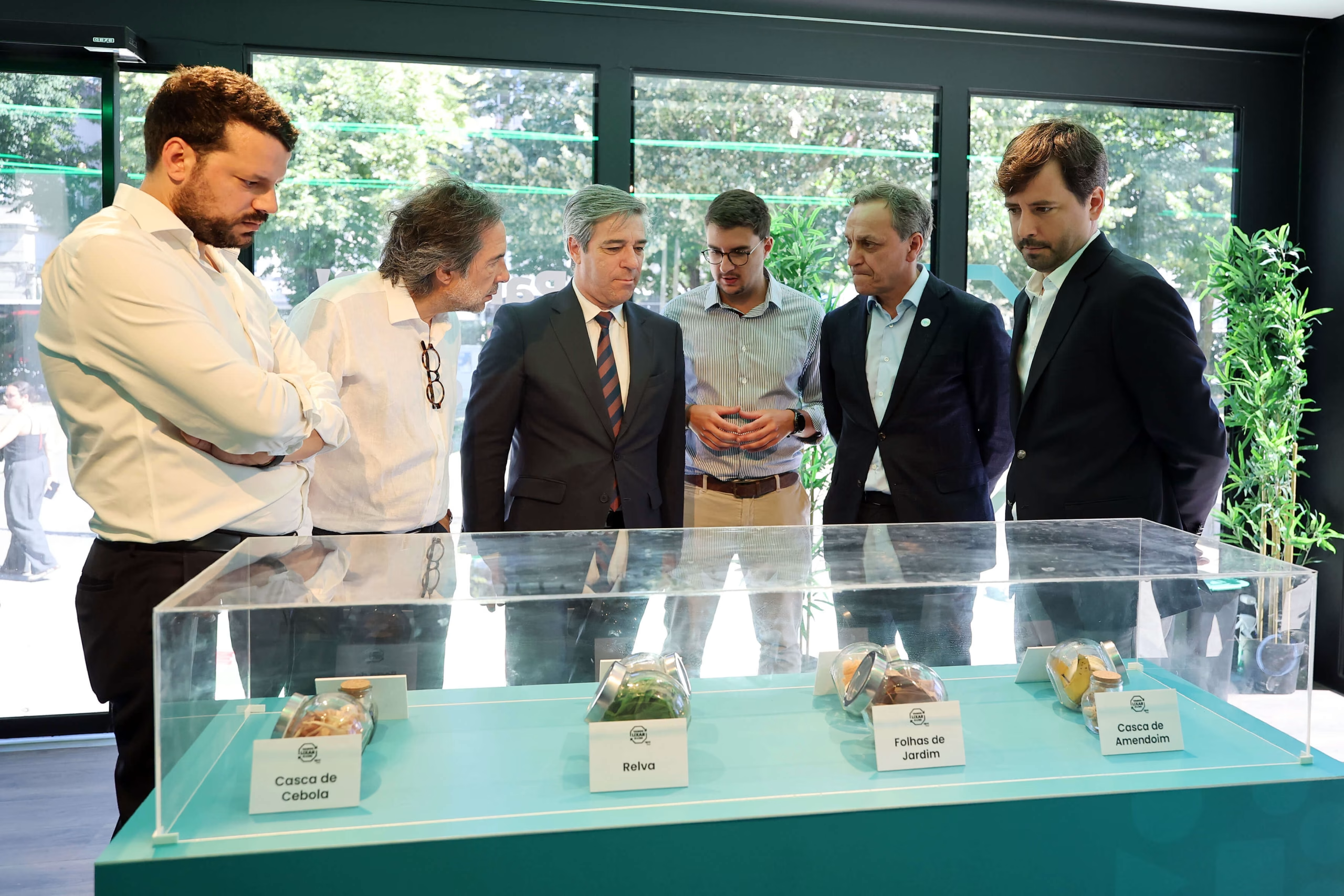
APA’s president reiterated key national waste management targets to underscore the call for waste separation. Alongside the Secretary of State for the Environment, João Manuel Esteves, and the Mayor of Braga, João Rodrigues, he emphasized that this is a collective effort involving both the central government and local authorities.
“We have a target for 2035: we need to reach a 65% rate [for waste separation]. So, we have to move—we have to pick up the pace. As I mentioned, we currently send over 50% of waste to landfills, and we must reduce that to 10% by 2035. This is a major challenge for the country. We all have a role to play in this,” he stressed.
The “Let’s separate the waste” campaign is touring the country with a physical installation featuring exhibits, information, and games designed specifically for children and young people; the site is also open to school visits, as highlighted by João Manuel Esteves.
“Younger people have a major advantage: they force us all to think. We have to do better; we have to sort our waste (…). We want a circular economy—one that makes use of exactly what we throw away, turning it into value,” said the official, highlighting the importance of this campaign, which takes place in the summer because that is when the most waste is generated. “It is in the summer that we produce the most waste.
It is in the summer—during those four months from June to September—that the country generates 40% of its total waste. Each of us produces half a ton of waste annually. That is 519 kilograms a year, or 1.4 kilograms a day. And within that 1.4 kilograms, bio-waste accounts for 40%,” noted APA’s president.
Pimenta Machado added another appeal: “The best waste is the waste that isn’t produced in the first place—hence our focus on prevention and our daily choices. We often end up burying valuable products; if you sort your waste, you can extract value from it, create a product, or even produce green gas.”
After the summer focus, the “Let’s separate the waste” campaign will continue through the end of the year.
The roadshow includes a quiz to test public knowledge on proper waste sorting, a sustainable consumption simulator that identifies consumer profiles, workshops for creating art from recycled materials, and games. It also features an “mural of excuses,” displaying the reasons people often give for not sorting their waste correctly.
The APA—a public institute within the State’s indirect administration—is the entity responsible for implementing environmental policies in Portugal, with a mandate covering monitoring, planning and assessment, licensing, and enforcement.