Three million tonnes of waste end up in landfills every year

Three million tonnes of waste end up in landfills every year, the Portuguese Environmental Agency (APA) warned on Monday when launching the second phase of an awareness campaign on the waste problem.

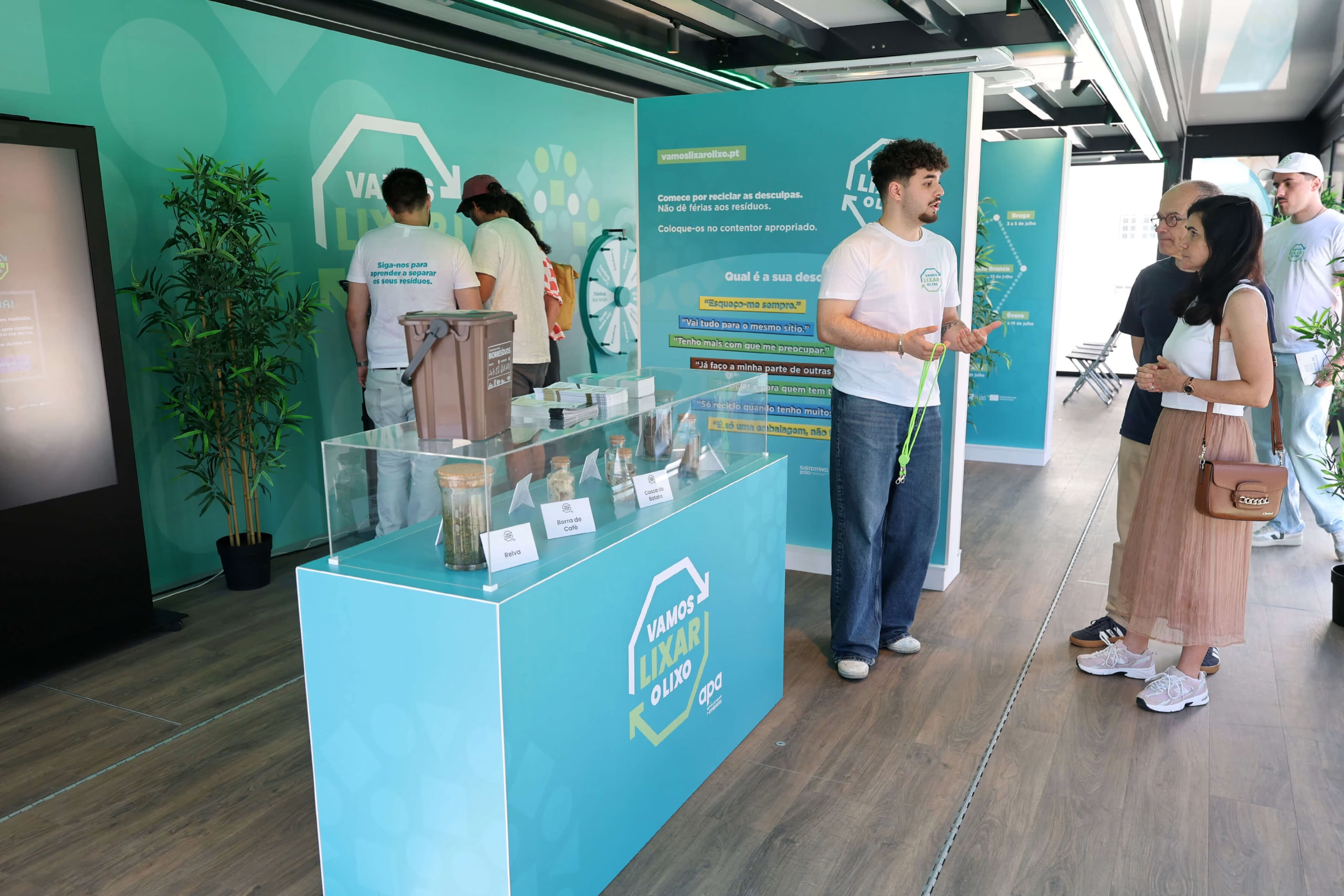
During the sales season, the APA’s action will focus on shopping centres across various cities, drawing attention to the fact that more than 50% of the waste produced is deposited in landfills.

“Let’s separate the waste before our future is wasted.” is the rallying cry of the new campaign, with which the APA aims to change behaviour and encourage waste separation.

“The solution is within everyone’s reach and involves the proper separation of the waste we produce at home (glass, plastic and metal packaging, paper and cardboard, and bio-waste), with a view to sending it for recycling,” the APA stated in a press release.

In shopping centres, the APA stand is an information space dedicated to the topic of bio-waste, featuring a children’s area with games and interactive learning, as well as a quiz zone that challenges visitors’ knowledge of recycling.

Several more initiatives will take place until the end of the year, with the same purpose.

Source

APA warns that more than half of the waste produced in Portugal goes to landfill

Three million tonnes of municipal waste end up in landfills every year — meaning more than half of all waste discarded in Portugal annually — the Portuguese Environmental Agency (APA) warned on Monday when launching the second phase of an awareness campaign about this “monumental” problem.

Under the tagline “Let’s separate the waste before our future is wasted.”, the campaign adopts a multimedia strategy encompassing television, radio, billboards and digital platforms, aiming to raise awareness among citizens about the urgent need to separate and properly route their household waste.

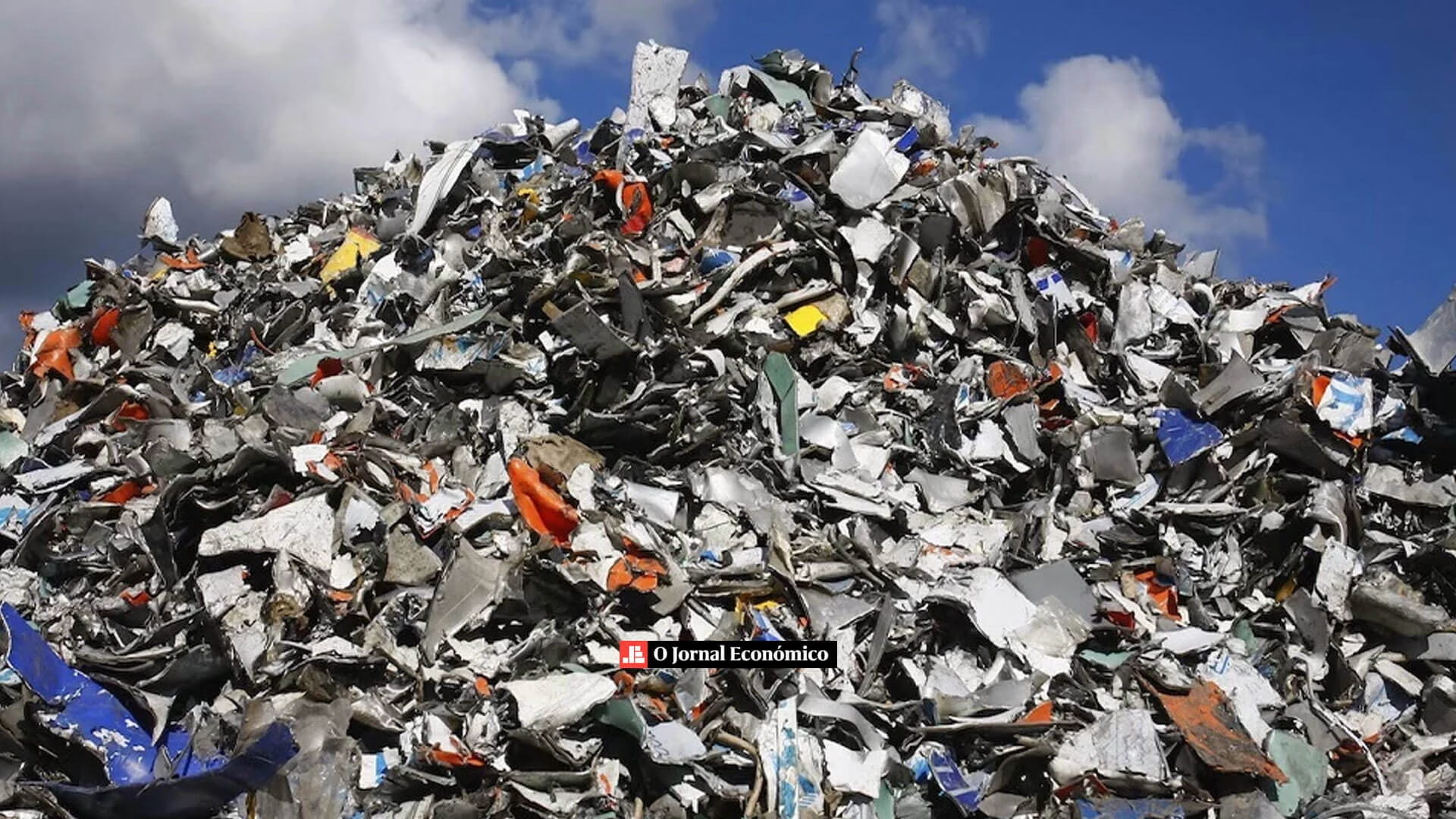
In the television campaign, a tour guide drives a tuk-tuk through the streets of Lisbon, presenting iconic monuments such as the Palácio Nacional da Ajuda and the Mosteiro dos Jerónimos, before revealing an “unexpected monument”: a colossal mass of municipal waste, illustrating the three million tonnes that are deposited in landfills every year.

The campaign serves as a warning about how poor waste separation is exhausting national landfill capacity and undermining sustainability, according to the APA’s press release. The agency emphasises that the solution is within everyone’s reach and involves the correct separation of glass, plastic and metal packaging, paper and cardboard, as well as bio-waste — food scraps and garden green waste — for subsequent recycling.

In the height of the sales season, the campaign will include activations at the Colombo Shopping Centre in Lisbon, from 13 to 18 January, and at Norte Shopping (owned by Sonae, which also owns PÚBLICO) in Matosinhos, from 27 January to 1 February, with an information space dedicated to bio-waste, educational games for children, and a recycling quiz.

Race to meet the targets

The “Let’s separate the waste” campaign is planned to run for 15 months and involved an investment of €4.3 million. The APA’s ambition is to drive a “social movement” capable of changing the recycling habits of the Portuguese and reducing the country’s enormous current dependence on landfills. This initiative is also part of a race against the clock to meet the European sustainability targets by 2030.

Several Portuguese landfills are approaching capacity. Moreover, the majority of these facilities in Portugal operate outside the bounds of national law and EU rules, receiving undifferentiated municipal waste without it being subjected to the separation and stabilisation of organic matter. The environmental association Zero reported to the European Commission in November the illegal operation of 28 of the country’s 31 landfills.

Out of a total of 5.3 million tonnes of municipal waste, 14% is recycled, 8% goes to organic recovery, 12% to energy recovery, and 59% to landfill disposal. The environmental association Zero advocates a greater focus on organic recovery (over incineration) through increased capacity and efficiency in mechanical and biological treatment at landfills.

Source

prevenção de resíduos

Waste Prevention

Waste prevention and management must be carried out in accordance with the principles of the waste hierarchy, which aims to transition towards a circular economy and achieve a high level of resource efficiency. It must follow this order:

a) Prevention;
b) Preparation for reuse;
c) Recycling;
d) Other types of recovery;
e) Disposal.

Around 5.5 million tonnes of waste are produced every year, and one of the main objectives of waste policy is to reduce this figure.

Prevention — the principle at the top of the waste hierarchy pyramid — involves implementing measures that enable a real reduction in the quantity of waste produced. Citizens, as waste producers, play a key role and can contribute to this goal through informed consumer choices and by adopting practices that facilitate the reuse of products or materials, thereby extending their useful life. Donating, purchasing reusable products, or choosing products that are not single-use whenever alternatives are available on the market are all actions that contribute to an effective reduction in waste production.

However, this is not solely a responsibility for citizens. Those who sell products must also adopt measures that extend the useful life of the products they sell (for example, by providing spare parts that allow products to be repaired). Prevention is not limited to materials and products — there is also a very significant dimension relating to the fight against food waste.

It should be noted that for waste whose production cannot be avoided, citizens should adopt behaviours that ensure it is sent to the correct bins, thereby guaranteeing that it is recycled or directed towards other forms of recovery.

For more information, visit the Portuguese Environmental Agency’s website at www.apambiente.pt

Thumbnail do vídeo

Manhãs CMTV

During the Christmas season, the Portuguese Environmental Agency carried out an awareness campaign, highlighting the need for the Portuguese people to unite in reducing the impact of waste on the country.

The “Waste Shop” was present at the Cascais Christmas Village for a simple and educational activity. Starting with the separation of waste at home, which is the most important thing, people were challenged to bring their properly separated municipal waste from home and hand it over to a promoter who had a scale to weigh the waste. In exchange, people received a ticket that gave them access to different gifts.

With comments from Francisco Silva, from the Sectoral Waste Division of the Portuguese Environmental Agency, and Sílvia Ricardo, director of the Waste Department of the Portuguese Environmental Agency.

Thumbnail do vídeo

CNN Report

Christmas is also synonymous with a great deal of waste. To raise awareness of this problem among the Portuguese, the Portuguese Environmental Agency created a 6-metre-high Christmas tree made from poorly separated waste from our own homes.

With statements from José Pimenta Machado, Chairman of the Board of the APA.

Thumbnail do vídeo

Manhãs CMTV

At Christmas, the Portuguese Environmental Agency launches the campaign “Let’s separate the waste before our future is wasted.”, calling for the separation of biowaste. Christmas is a particularly important time because separation starts at home. Report at ValorSul. ValorSul is a system that brings together several municipalities in the Lisbon area and handles their waste treatment. There are 19 municipalities in this zone, and a range of treatments are carried out on the waste to recover it, add value to it and turn it into resources.

With comments from Ana Cristina Carrola, member of the Board of the Portuguese Environmental Agency.